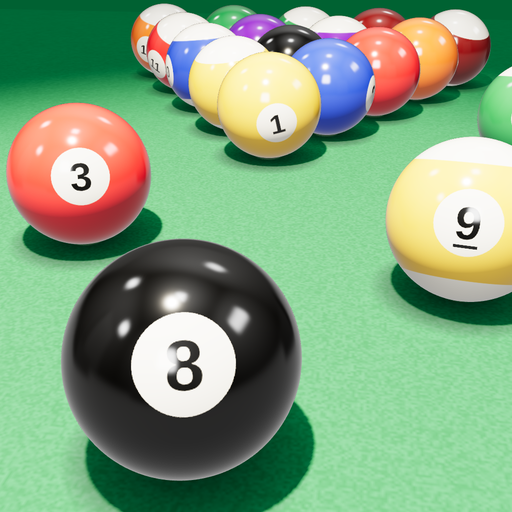
Beginners in 8-ball think about one thing: getting the object ball into the pocket. Better players think about where the cue ball will stop afterwards. That second thought is called position play, and it is the difference between potting one ball and clearing the table.
Why position matters more than the pot
Most pots on an open table are not difficult. What makes a shot hard is a bad angle, a long distance, or a ball sitting in the way. You create most of those problems yourself with the previous shot.
If every shot leaves you a short, straightforward pot on the next ball, you never face a hard shot at all. Good players look like they are making easy shots because they keep giving themselves easy shots.
The three basic cue ball shots
Where you strike the cue ball changes what it does after hitting the object ball. On a straight-in shot (cue ball, object ball and pocket in a line), the effect is easiest to see.
Stun: the cue ball stops
Hit the cue ball at or slightly below centre with medium pace, so that it is sliding, not rolling, when it reaches the object ball. On a straight shot the cue ball stops dead where the object ball was. This is called a stop shot.
On an angled shot, a stunned cue ball leaves the object ball along the tangent line: a line at 90 degrees to the path the object ball takes. Learning to picture this tangent line is the single most useful skill in position play, because it tells you where the cue ball is heading before you shoot.
Follow: the cue ball rolls forward
Hit above centre. The cue ball has forward roll when it meets the object ball, so after contact it keeps moving forward, following the object ball. On an angled shot, follow bends the cue ball’s path forward from the tangent line.
Use follow when your next ball lies further along the same direction.
Draw: the cue ball comes back
Hit below centre with enough pace. The cue ball has backspin when it reaches the object ball, so after contact it pulls back towards you. On an angled shot, draw bends the path backwards from the tangent line.
Draw is how you avoid following a ball into the pocket, and how you come back for a ball behind you. Draw fades with distance: the further the cue ball travels before contact, the more of its backspin turns into ordinary forward roll, so long draw shots need more pace.
Side spin: use it sparingly
Hitting left or right of centre adds side spin. It mainly changes the angle the cue ball takes off a cushion. It is useful, but it also makes the pot harder because the cue ball and object ball behave less predictably. Most position can be played with centre-line hits alone: stun, follow or draw, plus the right speed. Add side spin only when those cannot get you there.
Speed is half of position
Players often get the direction right and the distance wrong. A cue ball that goes the correct way but travels a metre too far is still out of position.
A few habits help:
- Pick a target zone, not a target spot. Aim to stop the cue ball in an area where several shots on the next ball are possible. A zone is much more forgiving than an exact point.
- Use the softest speed that works. Soft shots are more accurate and the ball rolls truer. Hit hard only when you need to.
- Think about angle before you shoot. A slight angle on the next ball is usually better than a perfectly straight one, because an angle lets you send the cue ball where you want. A dead straight shot only gives you stop, follow or draw along one line.
Planning a run-out
A run-out means potting all of your group and then the 8-ball in one visit. Before the first shot, especially with ball in hand, take a moment to plan the whole sequence.
1. Find the problem balls first
Look for any of your balls that are touching another ball, sitting against a cushion, or blocked from every pocket. These are the balls that end runs. Decide early when and how you will deal with them: often by using an easier shot to bump them free with the cue ball.
2. Plan backwards from the 8
Look at where the 8-ball is and which of your balls will be your last one. That last ball should leave you an easy shot on the 8. Then choose the ball before it, and so on. Working backwards stops you from leaving your final ball in an impossible spot.
3. Prefer short, natural moves
Choose an order where the cue ball only has to travel short distances with natural angles. Long journeys around the table, through traffic, are where position goes wrong.
4. Take the key ball seriously
The ball you pot just before the 8 is often called the key ball. Choose it so that the cue ball can easily stop in a good place for the 8. Players frequently clear six balls and then lose the frame because their key ball left no shot on the 8.
5. Re-plan after every shot
The cue ball rarely stops exactly where you planned. After each shot, look again and adjust the plan.
Using ball in hand well
After your opponent fouls, you get ball in hand: you can place the cue ball anywhere. Do not just place it for the easiest pot. Place it for the easiest pot that also gives a simple path to the next ball, or for a shot that breaks up a cluster while potting a ball. Ball in hand is the best chance to run out, so it is worth a few extra seconds of planning.
When to play a safety instead
Not every turn should be an attack. If you cannot see a run-out and the next pot is risky, a safety is often the better choice: a shot that leaves your opponent with no good pot.
Common safety ideas:
- Hide the cue ball behind one of your own balls so your opponent cannot see any of theirs.
- Leave the cue ball long, frozen to a far cushion, so any shot is difficult.
- Tie up their balls by nudging your ball next to theirs or near their best pocket.
Remember the basic legal-shot rule: you must hit one of your own group first (or the 8 when you are on it), and after contact a ball must reach a cushion or a pocket. Missing either is a foul and gives your opponent ball in hand, which ruins a good safety.
Practise in Swoqy’s billiards games
Pool Hustle is Swoqy’s 8-ball game: you break, claim solids or stripes and clear the table against computer opponents on 16 tables. You set spin on the cue ball and pull back to choose power, which makes it a good place to practise stun, follow, draw and planning a run-out with ball in hand.
Billiards Hustle is carom and 3-cushion billiards rather than 8-ball, but it trains the same core skill: knowing where the cue ball goes after contact, how spin changes its path off the cushions, and how speed decides where it stops.