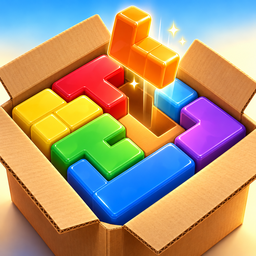
A packing puzzle gives you a container and a set of shapes, and asks you to fit all of them in with no overlaps and nothing sticking out. The classic version is made of pieces built from joined squares, but the same thinking applies to puzzle boxes, tile layouts and even loading a real trunk.
These puzzles reward a method more than inspiration. Players who drop pieces in at random can spend ten minutes shuffling the same arrangement. Players who follow a few principles usually find the answer in a handful of attempts. This guide explains those principles.
What makes a packing puzzle hard
Two things make fitting puzzles tricky.
First, shapes can be turned, and sometimes flipped, so one piece can sit in many positions. Second, every placement changes the empty space that remains. A piece that fits well now can leave a hole that no remaining piece can fill.
Good strategy deals with both. You reduce the number of options by choosing the most restricted piece or spot first, and you keep the leftover space in useful shapes.
Start with the numbers
Before placing anything, do some quick arithmetic.
- Count the container’s cells. For a grid-based puzzle, this is the number of open squares.
- Count the cells in all pieces. Add up the squares in every shape.
- Compare. If the totals match, the pieces must fill the container exactly, and there is no room for waste at all. If the pieces total less, you have a little slack, but not much.
A match tells you something important: every single empty cell must be covered. That makes small holes serious problems, as the section on dead ends below explains.
Also note the container’s outline. Many boxes have missing corners or cut-out areas. Only the open floor counts, so plan around the real shape rather than a plain rectangle.
Place the big and awkward pieces first
This is the most reliable rule in packing, in puzzles and in real life. Large pieces and irregular pieces have the fewest places they can go. Small pieces are flexible and can fill almost any gap, so they should wait.
- Big pieces first. A five-cell shape has far fewer legal positions than a two-cell one.
- Awkward shapes next. Crosses, zigzags and long thin pieces are hard to fit later, when the space has become fragmented.
- Small and square pieces last. Squares and short pieces act as filler, and you want plenty of them left at the end.
If you save the flexible pieces for the end, they absorb the mistakes you made earlier. If you use them early, you lose that safety margin.
Use the corners and edges
Corners limit a piece’s orientation. A shape in a corner can usually sit in very few ways, which makes it easy to see what fits. The same is true along an edge, where one side is already closed.
- Fill corners first. Look for the piece whose shape matches a corner best, such as an L-shape in a right-angle corner.
- Work along the walls. Once the corners are done, continue along the edges so the empty space stays in one connected block.
- Leave the middle for later. If you fill the centre first, you often split the free space into small, odd pockets.
Treat any fixed obstacle in the box, such as a piece that cannot be moved, as an extra wall. Its sides work like edges.
Leave useful gaps
The goal of each placement is not only to fit one piece but also to leave good space for the others. Ask yourself two questions after every move.
- Is the remaining space still in one piece, or have I created an isolated pocket?
- Could a piece I still have fit into each pocket?
An isolated pocket of three cells is only useful if you have a three-cell piece left. If every remaining piece has four cells or more, something needs to change. Checking this takes seconds and saves a lot of trial and error.
The single-cell hole
The worst thing you can leave behind is a single empty cell surrounded by pieces. Only a one-cell piece can fill it. If you have none, that arrangement is dead, however good the rest looks. Whenever a placement would leave a single-cell hole, look for another position or orientation.
Count the pocket sizes
When the space splits, count each pocket’s cells and match them to your remaining pieces. If you have pieces of 4, 3 and 2 cells, pockets of 4, 3 and 2 cells are perfect, and a pocket of 5 can still work as 3 plus 2. A pocket of 1 or 6 with no matching combination tells you to undo your last placement.
Use rotation before you drop
Turning a piece is cheap. Dragging and dropping it in the wrong orientation is not, especially when moves or time are limited.
- Decide where a piece will go first, then turn it to match before placing it.
- Compare the piece with the gap: where is the thick part, and where is the narrow part?
- Some puzzles lock certain pieces in one orientation. Place those first, because they have no flexibility, and fit the others around them.
Know when to back out
Every packing puzzle has dead ends. The skill is noticing them early instead of pushing on.
- Set yourself a limit. If you have rearranged the same corner three times, the problem is probably elsewhere.
- Remove the right piece. Take out the most recently placed piece that creates the awkward hole, not the whole box.
- Rebuild from the constraint. Go back to the most restricted piece, place it differently and continue.
A useful trick is to ask which piece could not fit anywhere else. If one shape has only one possible location, it is probably the key to the whole puzzle.
Common mistakes
- Filling the centre first. This breaks the space into awkward pockets.
- Using small pieces too early. They are your flexible reserve.
- Ignoring the arithmetic. A quick cell count shows when a design cannot work.
- Leaving single-cell holes. These are dead ends unless a one-cell piece remains.
- Forgetting the outline. Cut corners and fixed obstacles are part of the puzzle.
- Trying random placements. Every move should answer a question about what fits where.
Try it in Pack It Perfect
Pack It Perfect is Swoqy’s packing puzzle. Each level gives you a box drawn as a grid and a tray of items made of square cells. You drag items into the box and tap one to turn it, and every box has at least one solution. Levels add ideas gradually, including locked items that cannot be turned, parcels already inside the box and odd-shaped boxes, so the habits above (biggest pieces first, corners first, no single-cell holes) are the ones to practice.