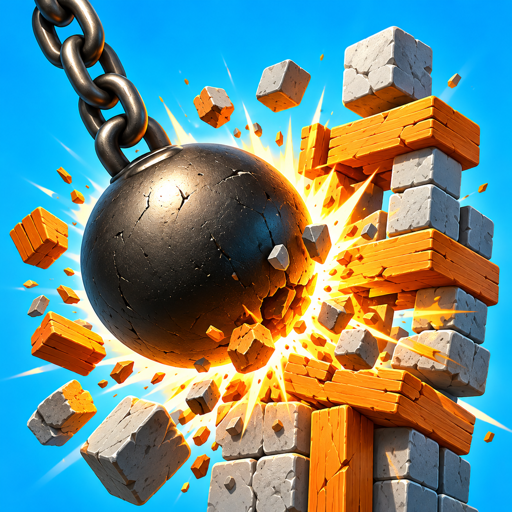
Demolition puzzles look like games about destruction, but the best players treat them as games about structure. Every tower is a stack of pieces held up by a few key supports. If you can find those supports and remove them in the right order, a small shot brings down a large building. This guide explains the physics ideas behind that and how to turn them into fewer shots per level.
Think in supports, not in blocks
A tower stands because the weight of everything above rests on something below. Remove that something and the weight above has nowhere to go but down. So the first question for any structure is not “where can I hit the most blocks?” but “what is holding this up?”
Look for three kinds of supports:
- Columns and pillars. A single narrow column under a large mass is a strong candidate. If it goes, everything above loses its base.
- Beams and bridges. A horizontal piece that spans a gap carries load across it. Knocking out a beam, or one of its two ends, tends to drop the section that rested on it.
- Corner and edge blocks. Where a platform rests on a few blocks at its edges, removing one edge can tip the whole platform.
A structure with many equal supports is much harder to bring down than one with a single weak link. When you see a level that looks solid, search for the one place where the load is concentrated.
Center of mass and why towers fall
An object stays upright as long as its center of mass is above the area that supports it. Push it so that the center moves past the edge of that area and it begins to tip, and gravity does the rest.
This has practical consequences:
- Low hits remove the base. Hitting near the bottom takes away the support under the whole structure. The part above is still intact when it starts to fall, so it keeps falling as one piece and crushes whatever is below.
- High hits tip, not break. Hitting a tall, thin tower near the top applies force far from the base and can topple it like a falling tree. This works on tall, narrow structures but is less reliable on wide, heavy ones.
- Heavy parts above light supports are unstable. If a large block sits on a thin or light support, a small shot can bring it down.
A good rule is to start low when the structure is wide, and consider a high hit when it is tall and thin.
Materials matter
Different materials react differently to a hit.
- Wood breaks and splinters relatively easily and is a good place to start when you need to open a gap.
- Stone is heavy. It resists light hits, but once it moves it carries a lot of momentum and pushes whatever it meets.
- Ice is brittle. It shatters but often slides, so the pieces can travel farther than you expect.
- Steel is hard to break. In most cases it is better to hit the pieces around it than to fight it head on.
Momentum explains a lot here. A heavy object moving quickly pushes harder than a light one moving slowly, which is why heavy balls and fast throws shift stone and steel. But more power is not always better. A very fast shot may pass through a weak spot without transferring much, or it may fly over the top of the structure.
Angle and power
Many players throw at full power every time. A better approach is to match the shot to the target.
- A flat, fast shot hits low structures and supports directly. It pushes blocks sideways rather than up.
- A lobbed shot comes down from above, which suits pieces sitting on top of a structure or targets sheltered behind a wall.
- A medium shot into the base is often the most effective. It has enough force to shift a support and not so much that the ball bounces away.
When your game shows a preview line, use it to check the first contact, then think about what happens next. The preview shows where the ball will start hitting things, but it cannot show the collapse that follows. Your job is to predict the collapse.
Timing and moving parts
Many levels contain parts that swing, slide or rotate. They follow a fixed rhythm, so patience beats speed.
- Watch one full cycle before throwing.
- Estimate how long your ball will take to arrive.
- Release so the ball reaches the moving part when it is in the right place.
A ball that arrives a fraction late can bounce off a part that was exposed a moment earlier. Repeat the same pull strength so your timing stays consistent between attempts.
Timing also matters after you throw. Blocks keep sliding and tipping for a second or two after a hit. If you throw again too soon, you may waste a ball on a tower that was about to fall by itself. Wait for the movement to settle, then judge what is left.
Starting a chain collapse
A chain collapse is when one falling piece knocks over the next, which knocks over the next. It is the most efficient way to clear a level, because the structure does most of the work.
To set one up:
- Find the heaviest, highest piece that can be dislodged. It will deliver the most energy when it falls.
- Aim at the support that lets it fall onto other structures. A piece falling away from the rest of the tower does little. One falling across the tower hits more.
- Look for explosives and reactive blocks. Where a level contains blocks that detonate when struck, hitting one can set off its neighbours.
- Think in sequences. Imagine the first piece falling, what it hits, and what that falls onto. If the chain ends early, look for a different first hit.
Chain reactions are also what creates large combos in games that count them, so building them is worth doing even when a simpler shot would barely meet the goal.
Using fewer shots
If your score depends on the number of shots you have left, efficiency matters as much as success.
- Spend your first shot on the biggest structural weakness. It should do most of the work.
- Aim the second shot at what remains, not at the debris. Rubble on the ground does not count for anything in most levels. The target is what is still standing.
- Check the goal type. If you need to destroy specific marked pieces, knocking down the rest of the tower may not count. Clear a path to the marked blocks instead.
- Use special tools where they fit. Heavier balls suit dense stone, explosives suit clusters, and a ball that affects blocks of one color suits a mixed tower. Using the right tool can save an entire shot.
- Retry with what you learned. A failed first attempt tells you how the structure moves. Use it to choose a better opening shot.
A routine for every level
- Read the goal.
- Find the load-bearing pieces.
- Choose the first shot: low and flat, lobbed, or timed against a moving part.
- Throw, then wait for everything to settle.
- Reassess the remaining structure and repeat.
Try it in Tower Demolition
Tower Demolition: Ball Smash is built around these ideas. Each level gives you a limited number of balls, and the structures use wood, stone, ice and steel, so finding the weak point and planning a collapse is the way to earn more stars.